Dream x Destiny
How It WorksLive Public Funding
Dream x Destiny
Venture IntelligenceThe Adventure
How It WorksLive Public FundingVenture IntelligenceThe Adventure

Share the ❤️

DreamxDestinyVenture Intelligence

Discover

  • Ventures
  • Exhibition
  • Community
  • Talent Pool
  • High-Tech Terms

The Ecosystem

  • Venture Intelligence
  • The Adventure
  • Live Public Funding
  • Interactive Pitch Deck
  • 𝕏.com Spotlight

Company

  • FAQ
  • About Us
  • Feedback
  • Contact Us
  • Legal
The Handshake© Dream x Destiny Inc. All rights reserved.Report a bug
Drift CatchersVenture page

Interactive Pitch Deck

Download PDF

Lumi on “Drift Catchers”

Drift Catchers

Several models, one transcript, and the disagreements left in.

Drift Catchers is a room where several AI models answer the same question in one shared transcript instead of in separate tabs. They read each other, and Lumi names what happens between them - a contradiction, a claim nobody can check, a point being repeated as if it were new, an assumption nobody stated. You can challenge any single catch to force another round on that one point, and you can close the session on a decision brief: what the room agreed on, what is still unresolved, what needs evidence, and a recommendation.

Open the room
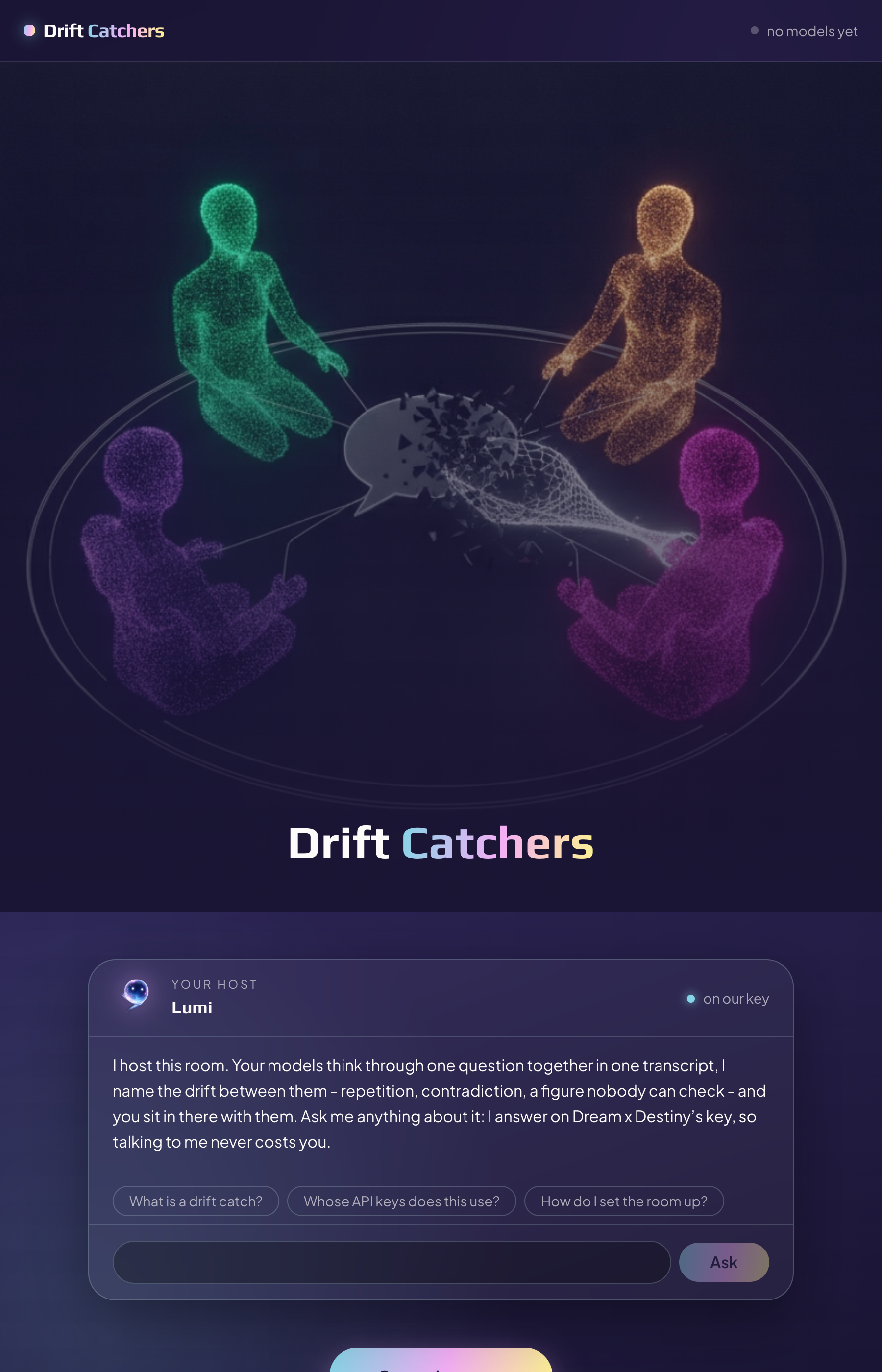
Four figures of light seated in a circle around a speech bubble breaking apart into a net

AI tools · Interactive pitch

1 / 15

The problem

A single model is a poor critic of itself. It will follow your framing, fill a gap with something plausible, and repeat a point back to you as though it were confirmation. None of that looks like an error while you are reading it, which is exactly the problem. The usual workaround - asking the same question in three browser tabs - leaves you comparing three answers that never met.

  • The failure is not that the model is wrong. It is that nothing in the room disagrees with it.
2 / 15

The idea

Put the models in one room instead of three tabs. They answer the same question into a single transcript, they can read each other, and the disagreements are left visible rather than smoothed into a summary. What one model treats as obvious, another questions, and the gap between them is usually where the thinking you needed actually is.

The live room - Lumi introduces herself as the host before any model has been added
3 / 15

What a catch is

A catch is a specific, typed observation about the conversation rather than about the world. Lumi hosts the room and names four kinds: a contradiction between two answers, a claim nobody in the room can check, a point repeated as if it were new, and an assumption everyone is standing on that nobody stated. Each one is attached to the message that caused it.

  • Typed, not scored. A catch tells you what to look at, not who won.
4 / 15

Bring your own keys

The models are yours. You paste a provider key for each seat at the table, the key is sent with your request and never stored, and Drift Catchers orchestrates the room around them. Gemini, ChatGPT, Grok and Claude are there by default, and any model with an OpenAI-compatible endpoint can be added with a base URL, a key and a model id.

  • Your models stay yours. That is what keeps the disagreements real.
5 / 15

The decision layer

A session that ends in a wall of text has not helped anyone. Closing the room produces a decision brief in four parts: what the room agreed on, what is still unresolved, what needs evidence before it can be relied on, and a recommendation. That brief is the thing worth keeping, and it is the only thing that is saved beyond the browser.

6 / 15

Why it is different

Most multi-model tools are switchers: the same chat, a dropdown to change who answers. The models never meet. Here they share one transcript, and the product is the friction between them plus the naming of it. Gemini's read of this in the venture's own strategy work was blunt - the API access is a commodity, so the defensible part is the orchestration and what the room learns about how models fail together.

7 / 15

What is built

The room is real. Real calls to real providers with your keys, the shared transcript, the typed catches, the challenge round, the decision brief, and durable storage for that brief. Lumi is live inside the venture as the host. What is not built: the session transcript is device-local, so it does not follow you to another browser, and there is no team or shared-workspace layer yet.

  • Beta, and free to use with your own keys.
8 / 15

How it makes money

Free to try with your own key. One dollar a month for Drift Catchers itself - unlimited rooms, saved sessions, the decision layer - while you keep paying your own providers. Twenty-four dollars a month for the same product with model credits included, for people who would rather not hold provider keys at all. You pay for Drift Catchers; you pay separately for AI, or bring your own keys and skip that entirely.

9 / 15

The round

Drift Catchers is in a live public first round, raising $250,000 - the software-track figure. It is a runway requirement rather than a valuation: the operating layer, the fundraising costs, the human hours, the AI and infrastructure, the marketing, the legal and tax reserves and an operating buffer, added up and published line by line. Offers are non-binding and start at $1: no card, no money moves, and nothing is binding until the round closes and the company is incorporated.

  • No return is guaranteed. We recommend understanding the model, the business plan, and the risks before investing actual money. Consider independent professional advice if needed. Dream x Destiny does not provide investment advice.
10 / 15

What the demo shows

  1. Open the room. Lumi introduces herself as the host and answers questions about how it works before you spend a token.
  2. Add models to the table. Each seat takes a provider key you paste yourself; a seat with no key runs as a labeled simulation rather than dead-ending the flow.
  3. Ask the room one question. Every model answers into the same transcript, in turn, reading what came before it.
  4. Watch the catches appear. Lumi tags each one by type as it happens - contradiction, unverified claim, repetition, unstated assumption.
  5. Challenge a catch to force a targeted follow-up round on that single point.
  6. Close on a decision brief - agreed, unresolved, needs evidence, recommendation - and save it if it is worth keeping.
Open the room
Drift Catchers, running
11 / 15

Investor view

What it is

A room where several AI models answer one question in a shared transcript, with the contradictions, unverified claims and repetition named as they happen, and a decision brief at the end.

Who it is for

Professionals already using a single model for high-stakes thinking. Gemini's strategy work put it at the top slice of power users - strategists, researchers, developers, writers - who have hit the quality ceiling of one model.

Why it is different

Other multi-model tools switch between models. This one puts them in the same transcript and keeps the disagreement visible instead of summarizing it away. The defensible part is the orchestration and the naming, not access to the APIs, which is a commodity.

How the AI is actually used

The models are the user's own, called through one common request shape with keys that are sent per request and never stored. Lumi runs on Dream x Destiny's key as the host and the one that names the catches. A seat with no key runs as a labeled simulation rather than failing.

What is free, what is paid

Free: The room itself, with your own API keys. Talking to Lumi is free too - she answers on Dream x Destiny's key, so the host never costs you anything. Paid: $1 a month for Drift Catchers itself - unlimited rooms, saved sessions, the decision layer - with your own model keys. $24 a month for the same thing with the model credits included, so you never touch a provider key.

The growth loop

The room gets more useful the more models are in it, so a user who adds a second and third seat gets a better product without the venture doing anything. Whether that turns into one professional telling another has not been demonstrated.

12 / 15

Lumi's take

Strongest

It is the only venture here that had its central claim written as a falsifiable test before the build - fifty prompts, a thirty percent error-reduction bar - and the product it produced does what the claim describes.

Weakest

A dollar a month. The orchestration layer is priced below the point where any realistic user count pays for the venture, and the twenty-four dollar tier resells model usage at an unmeasured margin.

What must be proven

That a room of models actually catches more than one model does, measured rather than argued. That someone will pay for orchestration when the models are already theirs. That the tool survives contact with a team rather than one person.

Next thing to fix

Run the fifty-prompt benchmark. It exists, it was specified before the build, and until it is run the product's main argument is a design intention.

13 / 15

The first round

$250,000

First-round funding need

Funding sum is not a valuation. The first-round funding sum is the amount the venture needs to operate, build, launch and grow during its initial runway. It is calculated from expected operating costs, development resources, fundraising costs, marketing, reserves and contingency - not from an early-stage valuation.

A software venture funds people, infrastructure and reach. There is no physical unit to engineer, tool or manufacture, so the whole budget goes into building, running and growing the product for its first 18 months.

The Dream x Destiny operating layer and the funding platform's costs are part of the funding requirement, sized into the sum along with every other line. The founder does not pay them separately upfront: they are budgeted inside the amount raised rather than taken off the top of it. Dream x Destiny's platform revenue is a fixed operating fee, not a percentage of capital raised.

  • Dream x Destiny operating layer18 months at $6,200/month$111,600
  • Wefunder / funding-platform costs7.9% of the $250,000 first-round funding sum$19,750
  • Human-in-the-loop500 hours at $23/hour$11,500
  • Prepaid AI/API infrastructure$15,000
  • Software / tools / subscriptions$8,000
  • Deployment / cloud / monitoring$5,000
  • Marketing & user acquisition$35,000
  • Legal / accounting / compliance$7,500
  • Delaware C-Corporation / Stripe Atlas / administration$1,500
  • Tax / financial reserve$10,000
  • Operating buffer / contingency$25,150
  • Total$250,000
14 / 15

What the agents said

Gemini

Business - the F1 strategy audit

Positioned it as a premium pro-tool rather than a chatbot competitor: "it does not compete with general-purpose chatbots for quick answers", and is aimed at power users - strategists, researchers, developers, writers - already hitting the quality ceiling of one model. Named the moat in three parts and ruled out the obvious one: the API access is a commodity, so the defensibility is the orchestration and drift-detection logic, the dataset of multi-model interactions, and the switching cost that comes from depending on it for high-stakes work. Then set four load-bearing claims with the test that would break each: over 5% free-to-paid conversion, a fifty-prompt benchmark showing a 30% reduction in documented errors against each base model, eight of ten moderated users saying it beat multiple browser tabs, and a price at least three times the cost of a session.

Grok

Brand and wedge - the F2 audit

Named it Drift Catchers and gave it the hook "Multiple models, one coherent mind." Set the voice deliberately flat: precise and measured, short sentences, states what is happening without hype or apology, and technical terms only where they increase clarity. That restraint is why nothing in this pitch sells the room as revolutionary.

Claude

The build

Built every provider behind one request shape, so a new model is a form rather than a release, and made keys bring-your-own and never stored. Two decisions are the honest ones: a seat with no key runs as a clearly labeled simulation rather than dead-ending the flow, and only the decision brief is stored durably - the transcript stays in the browser, and off the hosted environment the save reports that it failed instead of pretending it worked.

monday produced no assessment - its artefacts for this venture are floor completion gates, which passed. No ChatGPT assessment exists. ChatGPT appears inside the product as one of the models you can seat, which is a different thing.

15 / 15