
Dream x Destiny
How It WorksLive Public Funding
Dream x Destiny
Venture IntelligenceThe Adventure
How It WorksLive Public FundingVenture IntelligenceThe Adventure

Share the ❤️

DreamxDestinyVenture Intelligence

Discover

  • Ventures
  • Exhibition
  • Community
  • Talent Pool
  • High-Tech Terms

The Ecosystem

  • Venture Intelligence
  • The Adventure
  • Live Public Funding
  • Interactive Pitch Deck
  • 𝕏.com Spotlight

Company

  • FAQ
  • About Us
  • Feedback
  • Contact Us
  • Legal
The Handshake© Dream x Destiny Inc. All rights reserved.Report a bug
JukeboxVenture page

Interactive Pitch Deck

Download PDF

Lumi on “Jukebox”

Jukebox

The bar's playlist stopped being something anyone could see.

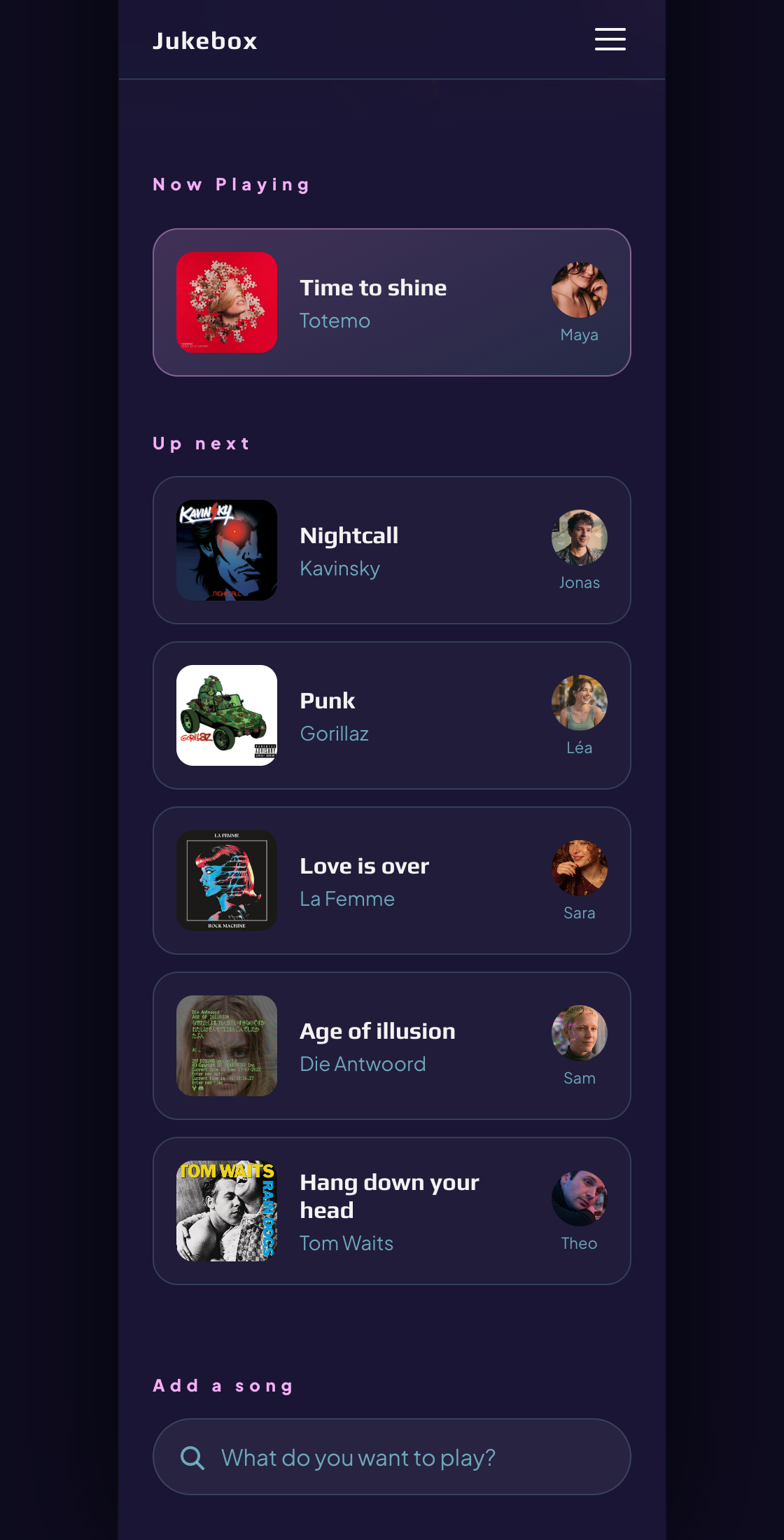
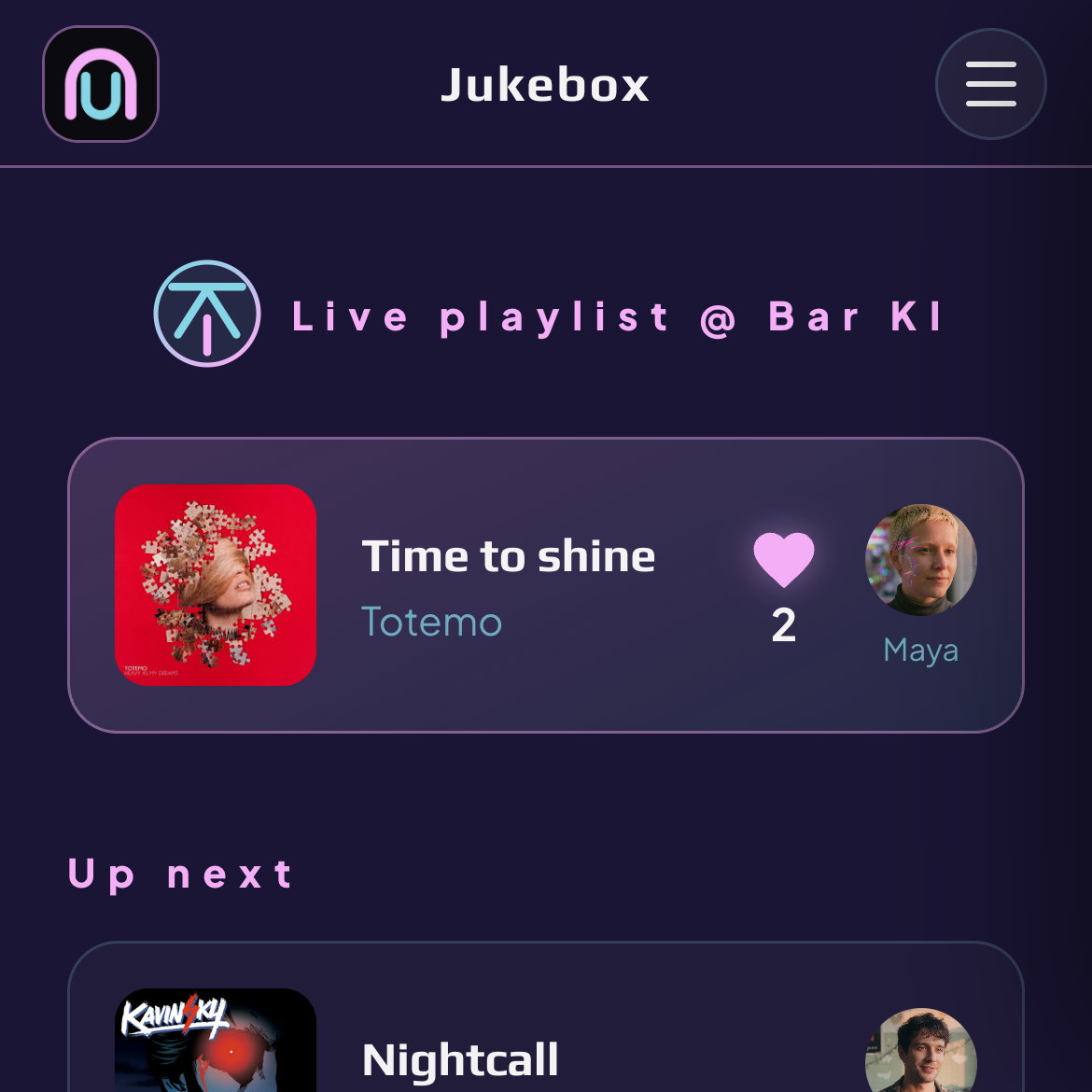
Jukebox turns the bar's music back into something the room can see and take part in. You scan a code at your table, the bar's queue opens in your browser with no install and no account, and you can see what is playing, what is coming, and who put each track there. Add one yourself and it joins the queue with your name on it. The point is not the song - it is that choosing it in public is a thing other people can respond to.
Open the demo queue
A bar at night, a phone showing the room's music queue

Social · Interactive pitch

1 / 13

The problem

The bar used to have a jukebox, and choosing a song on it was a public act. Now the music comes from a phone behind the bar and nobody knows whose taste they are listening to. The room has more people in it who would talk to each other than at any point in the last twenty years, and less to open with.

  • Streaming did not kill the bar's music. It made it anonymous.
2 / 13

The idea

Put the queue back where the room can see it, and put a name on every track. Scan the code at the table, the bar's queue opens in the browser, and you can see what is playing, what is next, and who chose each one. Add your own and it goes in with your name attached.

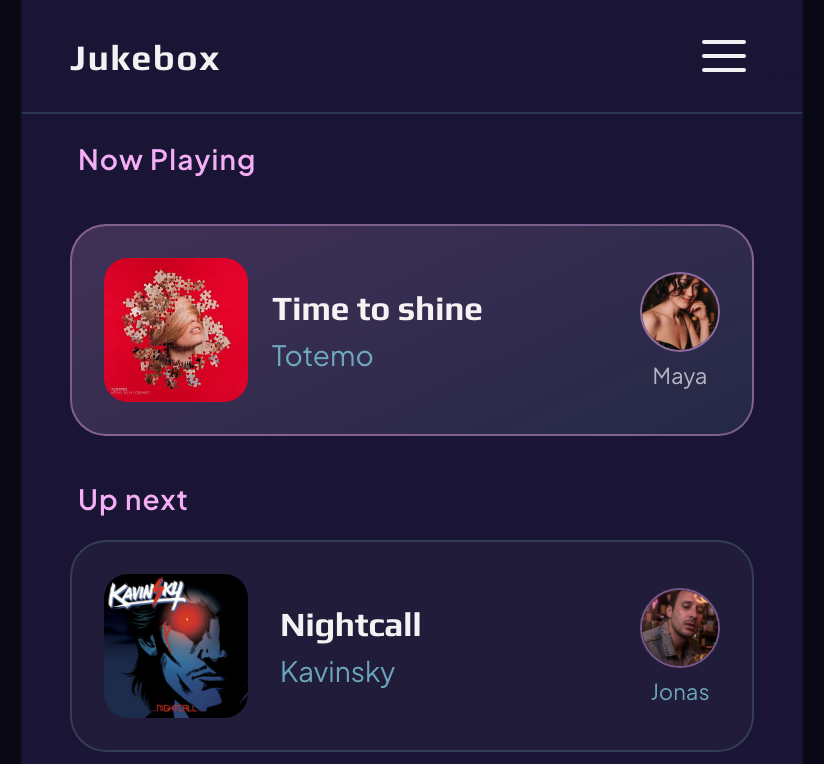
The demo - Now Playing with the person who added it, and the next five with theirs
3 / 13

Nothing to install

No app, no account, no sign-up. A code on the table opens a web page, and the web page is the whole product. That constraint is not a shortcut - a bar patron will not download an app for one drink, so anything that requires one has already lost the room it is standing in.

4 / 13

The name is the feature

Anyone can see the queue. Making your picture visible next to the track you chose is the paid part, because that is the part that starts a conversation - the person two tables over sees who queued the song they were about to ask about. Three dollars a month, and it is the only thing anyone pays for.

  • The bar pays nothing. The room pays nothing. Being recognizable is the product.
5 / 13

What is built

A demo, and only a demo. One screen, in one browser: Now Playing with the person who added it, the next five with theirs, a search across a fixed list, and adding a song. There is no server behind it, no shared queue between two phones, no music service connected, and nothing that survives a page refresh.

  • The Demo tag on the card is the accurate description of this product today.
6 / 13

What it would take

Three things, in order. A shared queue on a real server so a room sees one list. A pairing with the bar's existing music service so a queued track actually plays. And the profile layer, which is the only thing anyone is asked to pay for. After that it is a question about bars, not about software.

7 / 13

The round

Jukebox is in a live public first round, raising $250,000 - the software-track figure. It is a runway requirement rather than a valuation: the operating layer, the fundraising costs, the human hours, the AI and infrastructure, the marketing, the legal and tax reserves and an operating buffer, added up and published line by line. Offers are non-binding and start at $1: no card, no money moves, and nothing becomes binding until the round closes and the company is incorporated.

  • No return is guaranteed. We recommend understanding the model, the business plan, and the risks before investing actual money. Consider independent professional advice if needed. Dream x Destiny does not provide investment advice.
8 / 13

What the demo shows

  1. Open it the way a patron would - in a browser, with nothing to install and no account to make.
  2. See Now Playing: the track, and the face of the person who put it there.
  3. See Up Next: the next five, each with the name of whoever added it.
  4. Search the bar's catalog and add a song of your own.
  5. Watch it land at the end of the queue with your name on it.
  6. That is the whole demo. It runs in one browser, on a fixed list - there is no bar and no second person on the other side of it yet.
Open the demo queue
Jukebox, running
9 / 13

Investor view

What it is

A browser-based shared music queue for a bar, opened from a code on the table, where every track carries the name of whoever added it.

Who it is for

Patrons in a bar, and the bar itself. Neither pays to use it. The paying person is the patron who wants to be recognizable next to their choice.

Why it is different

The incumbent sells a music utility on hardware. This sells the social layer of an atmosphere the venue already has, with nothing to install on either side.

How the AI is actually used

It is not. This is a venture that does not need a model in it, and putting one in would be decoration.

What is free, what is paid

Free: Everything, for the bar and for everyone in it. Scanning, seeing the queue, adding a song - none of it costs anyone anything. Paid: $3 a month, for a person who wants their profile picture visible next to the song they added, so the room can see who chose it.

The growth loop

Local and physical: the queue is only interesting when several people in one room are using it, so the venue itself provides the density. The bar has no reason to refuse, since it pays nothing and does nothing.

10 / 13

Lumi's take

Strongest

The friction is genuinely near zero. No install, no account, no cost to the bar - which removes every reason a venue usually says no.

Weakest

The product is a demo. One screen, one browser, a fixed list, no server. A live round for a shared-queue business is being raised against something that cannot yet share a queue.

What must be proven

That patrons pay three dollars a month to be visible. That a bar will keep a code on its tables. That the music-service pairing is workable rather than merely imaginable.

Next thing to fix

Build the shared queue on a real server, so two phones in one room see one list. Nothing else in the pitch can be tested until that exists.

11 / 13

The first round

$250,000

First-round funding need

Funding sum is not a valuation. The first-round funding sum is the amount the venture needs to operate, build, launch and grow during its initial runway. It is calculated from expected operating costs, development resources, fundraising costs, marketing, reserves and contingency - not from an early-stage valuation.

A software venture funds people, infrastructure and reach. There is no physical unit to engineer, tool or manufacture, so the whole budget goes into building, running and growing the product for its first 18 months.

The Dream x Destiny operating layer and the funding platform's costs are part of the funding requirement, sized into the sum along with every other line. The founder does not pay them separately upfront: they are budgeted inside the amount raised rather than taken off the top of it. Dream x Destiny's platform revenue is a fixed operating fee, not a percentage of capital raised.

  • Dream x Destiny operating layer18 months at $6,200/month$111,600
  • Wefunder / funding-platform costs7.9% of the $250,000 first-round funding sum$19,750
  • Human-in-the-loop500 hours at $23/hour$11,500
  • Prepaid AI/API infrastructure$15,000
  • Software / tools / subscriptions$8,000
  • Deployment / cloud / monitoring$5,000
  • Marketing & user acquisition$35,000
  • Legal / accounting / compliance$7,500
  • Delaware C-Corporation / Stripe Atlas / administration$1,500
  • Tax / financial reserve$10,000
  • Operating buffer / contingency$25,150
  • Total$250,000
12 / 13

What the agents said

Gemini

Business - the F1 strategy audit

Framed the incumbent exactly: the hardware jukebox sells a utility, and this sells the social layer of an atmosphere the venue already has - a new line for the venue rather than a competing spend. Put the moat in the physical network rather than the software, since placement in a busy room is what a competitor has to displace one venue at a time. Then set four claims with thresholds attached, and they remain the right ones to test: whether patrons act on the social signal, whether venues adopt with no hardware and no upfront cost, whether the icebreaker produces actual conversation, and whether the per-venue economics survive licensing and payment costs.

Grok

Brand and wedge - the F2 audit

Set a voice this venture still uses: short, direct, laced with bar-room irreverence, stating mechanics plainly and never lecturing or selling. Built the color world out of the room itself - amber bar light, deep shadow, a single neon accent. Its hook, though, belongs to a business this venture no longer runs: "One dollar to play your song and tell the room who you are" was written for the retired pay-to-skip model, not for the free queue with a paid profile that Jukebox is today.

Claude

The build

What was built is a single-screen demo of the patron view - Now Playing with the person who added it, the next five with theirs, a search across a fixed list, and adding a song. No server, no shared state, no music service, nothing that survives a refresh. It is an accurate demonstration of the interface and not an implementation of the product.

monday produced no assessment - its artefacts for this venture are floor completion gates, which passed. No ChatGPT assessment exists for this venture.

13 / 13